

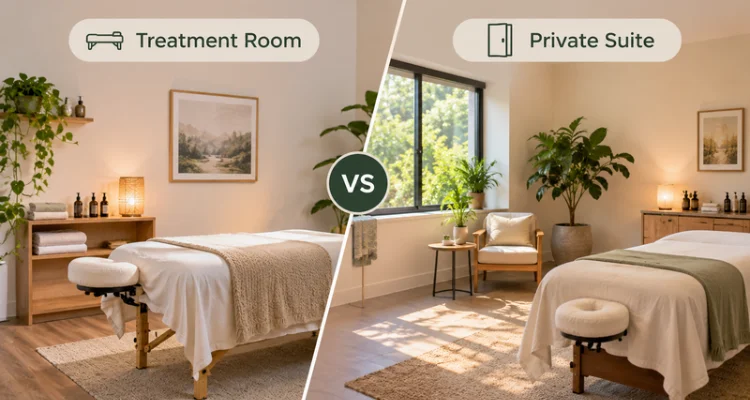
A treatment room may suit a lighter or more flexible caseload, while a private suite may make more sense when you need dedicated access, storage and greater control over your space. Neither option is universally better, and the right pick usually comes down to how full your schedule already is and how much autonomy your work requires. Wynhaven Wellness Community Center offers private and shared practitioner spaces, treatment rooms and consult spaces on its Forsyth-Dawson County line campus, serving massage therapists, bodyworkers and other wellness professionals across North Georgia.
Key takeaways
- A treatment room suits lighter or growing caseloads. It gives you the essential features for hands-on work without the cost of exclusive, full-time space.
- A private suite suits established, full caseloads. Exclusive use, more storage, and room for personal branding matter more once you’re seeing clients consistently.
- Owning or controlling your own space is increasingly common. Industry survey data shows a large share of massage therapists already work from their own dedicated office.
- Privacy needs differ by setup, not just by room size. A shared treatment room can still offer strong session privacy, while a small private suite can still feel cramped.
- Cost scales with exclusivity. A private suite typically costs more than a shared treatment room because you’re paying for guaranteed, full-time access.
- Branding and personalization favor a private suite. A space you control full time can reflect your practice’s identity in a way a shared room usually can’t.
- Scheduling flexibility favors a treatment room. Rotating or hourly access can match a lighter caseload without paying for hours you wouldn’t use.
- The right choice can change as your caseload grows. Many practitioners start in a treatment room and move into a private suite once demand supports it.
What’s the difference between a treatment room and a private suite?
A treatment room is a space built for hands-on work, such as a sink, a table, and sanitizable surfaces, that may be shared or rotated among practitioners on a schedule. A private suite is a dedicated, exclusive-use space reserved for one practitioner full time, often with more room for storage, personal decor, and a private waiting area. The core features overlap, but exclusivity, cost, and control are what actually separate the two.
Picture two bodyworkers with similar training opening a practice in the same month. One books a treatment room for the two afternoons a week they currently see clients, paying only for that scheduled time. The other signs for a private suite, furnishes it fully, and pays a flat rate whether the room is booked five days a week or two. Both choices can be correct, but only one of them matches a caseload that’s still filling in.
Not sure which setup matches your current caseload?
Reach out to our team to talk through treatment room and private suite options at Wynhaven.
Signs a treatment room is the better fit
A treatment room tends to be the right call when your schedule, budget, or growth stage still has room to change. Here’s what that usually looks like in practice.
- You’re still building your caseload. Paying for exclusive, full-time space before you need it rarely makes financial sense early on.
- You see clients a few days a week, not five. A rotating or scheduled treatment room matches a lighter schedule without the cost of unused hours.
- You don’t need heavy personal branding in the room itself. If your marketing lives mostly online or through referrals, a shared space does less to hold back your identity.
- You want to test a new location before committing further. A treatment room is a lower-risk way to see whether a space and its client flow actually work for you.
Signs a private suite is the better fit
A private suite tends to earn its cost once your practice has reached a point where exclusivity solves a real, ongoing problem rather than a hypothetical one. These are the clearest signals it’s time to consider one.
- Your caseload is consistent and close to full. A full schedule justifies paying for guaranteed, full-time access instead of a rotating slot.
- You need more storage than a shared room allows. Multiple modalities, retail products, or specialized equipment usually need dedicated space to store properly.
- Your brand depends on a consistent, personalized environment. A private suite lets you control decor, scent, and setup exactly the way your practice is positioned.
- You want full control over your schedule and room access. Exclusive use removes any coordination with other practitioners sharing the same space.
This split tracks with where the field is already headed. According to AMTA’s 2026 Massage Therapy Industry Fact Sheet, 40 percent of massage therapists report working from their own office, ahead of every other single work setting measured, which suggests a meaningful share of practitioners eventually move toward dedicated space as their practice matures.
Building toward a private suite as your caseload grows?
Connect with our team to see current treatment room and suite availability at Wynhaven.
Treatment room vs private suite: a side-by-side comparison
Here’s how the two options stack up across the factors that matter most day to day.
| Factor | Treatment room | Private suite |
|---|---|---|
|
Access
|
Shared or scheduled
|
Exclusive, full time
|
|
Cost
|
Lower, pay for hours used
|
Higher, flat ongoing rate
|
|
Storage
|
Shared or limited
|
Dedicated and private
|
|
Branding
|
Limited personalization
|
Full control over setup
|
|
Best for
|
Building or part-time caseloads
|
Established, full caseloads
|
Seeing your practice more clearly in one column than the other?
Get in touch with our team to find the right fit at Wynhaven.
How much more does a private suite typically cost?
Pricing varies by market and by what’s included, but the general pattern holds across most practitioner spaces: exclusive, full-time access costs more than shared or scheduled access, because you’re paying for guaranteed availability rather than a rotating slot. A private suite’s higher rate often also reflects more included storage, a private waiting area, and the ability to leave equipment set up between sessions instead of resetting the room each time.
The more useful comparison isn’t the sticker price alone, but the cost per session once you factor in your actual caseload. A treatment room can be the cheaper option in absolute terms and still cost more per session than a private suite, if a rotating schedule means you’re often paying for time you don’t fully use.
A quick way to sanity-check the math is to divide the monthly rate by the number of sessions you realistically expect to book. A treatment room priced for occasional use can look inexpensive on paper and still work out to a high cost per session if your actual caseload has grown past what a few scheduled hours can cover. Running that number before you sign tends to settle the decision faster than comparing headline rates alone.
Which setup fits your stage of practice?
Caseload stage is usually a better guide than preference alone, since a setup that feels appealing on paper can still be the wrong fit for where your schedule actually stands today.
| Practice stage | Typical caseload | Better fit |
|---|---|---|
|
Just starting out
|
Light, still building
|
Treatment room
|
|
Growing steadily
|
Several days a week
|
Treatment room or part-time suite
|
|
Established
|
Near full, consistent
|
Private suite
|
|
Multi-modality or retail
|
Full, with added services
|
Private suite
|
Not sure which stage your practice is really at?
Reach out to our team for an honest read on what fits your current caseload at Wynhaven.
Questions to ask before choosing between the two
A few direct questions can clarify the decision faster than weighing pros and cons in the abstract. Ask what your caseload looks like three months from now, not just today, since a treatment room that fits a light schedule can feel tight within a season of real growth. Ask how much you actually need to store between sessions, since oils, linens, and specialized equipment add up faster than expected. Ask, too, whether your clients would notice or care about a more personalized, exclusive space, since that answer differs by specialty and client base.
It’s also worth asking whether a space allows you to move between the two as your needs change. A treatment room that can later convert into a private suite removes the pressure to guess correctly on day one.
One more question worth asking directly: what happens if your caseload grows faster, or slower, than expected. A space that locks you into a single setup for a full year offers less room to adjust than one that allows a mid-term change, and that flexibility is often worth more than a slightly lower rate locked in for twelve months.
A few mistakes to avoid when making this decision
Choosing based on what a space looks like in photos, rather than what your actual weekly schedule requires, is one of the more common missteps. A beautifully appointed private suite still costs more per session if it sits empty three days a week. Underestimating storage needs is another frequent mistake, since oils, linens, and specialty equipment for even a single modality can outgrow a shared closet faster than expected.
Overcommitting too early is the mirror image of that problem. Signing a long-term private suite agreement before a caseload is established enough to support it can turn a growth decision into a financial strain. Starting in a treatment room and upgrading once demand is consistent is usually the lower-risk path, even if a private suite feels like the more exciting choice on day one.
A less obvious mistake is comparing the two setups only on price, without weighing what each one actually does for client experience and your own day-to-day routine. A slightly more expensive private suite that cuts your setup and cleanup time between sessions can pay for itself in the extra appointments you’re able to fit into a day, which rarely shows up when you’re only looking at the monthly rate.
Finding the right space for your massage or bodywork practice
Treatment room or private suite, the right space should match the practice you actually have, not the one you hope to have someday. Wynhaven Wellness Community Center offers both options on a nature-forward campus built for massage therapists, bodyworkers, and other hands-on practitioners, with room to move from one setup to the other as your caseload grows. If you’re ready to find the space that fits where your practice stands today, reach out to our team. We’ll walk you through current treatment room and private suite availability at Wynhaven.
Neither option is a permanent commitment to one way of working. A caseload that looks light today can fill in faster than expected, and a space built to grow with you means that shift doesn’t have to mean starting the search over from scratch.
Frequently asked questions
Is a private suite always better than a treatment room?
No. A private suite offers more exclusivity and control, but a treatment room is often the more practical and cost-effective choice for a lighter or still-growing caseload.
Can I start in a treatment room and move to a private suite later?
Many practitioners do exactly that as their caseload fills in. Ask any space directly whether this kind of upgrade is actually supported before you sign anything.
Does a treatment room offer enough privacy for massage sessions?
A well-designed treatment room can offer strong session privacy even when it's shared or scheduled, as long as sound privacy and clear booking protocols are in place.
How much storage does a private suite usually include?
This varies by provider, but a private suite typically includes more dedicated storage than a shared treatment room, which matters if you use multiple modalities or retail products.
What percentage of massage therapists work from their own office?
According to AMTA's 2026 Massage Therapy Industry Fact Sheet, 40 percent of massage therapists report working from their own office, more than any other single work setting measured.
Is a private suite worth it for a part-time practice?
Usually not yet. A part-time caseload is generally better matched to a treatment room's scheduled or hourly access, since a private suite's cost reflects full-time availability.
Can I personalize a shared treatment room at all?
Personalization is more limited in a shared space, though small, portable touches like your own linens or diffuser can still carry some of your practice's identity between sessions.
How do I decide which option fits my practice at Wynhaven?
Reach out to our team to talk through your current caseload and goals, and we'll help you compare treatment room and private suite options that fit where your practice stands now.

Wendy Skinner, BSN, RN, VABC
Wendy writes about community wellness, practitioner support, and restorative spaces, drawing on 15+ years of clinical experience and her experience building environments that foster healing, rest, and connection.